
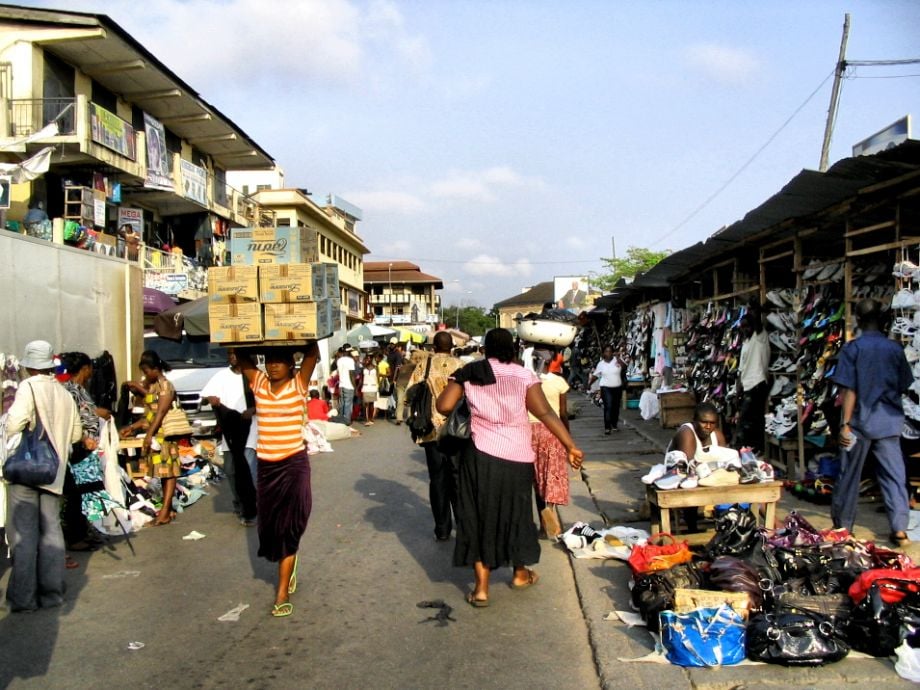
Photo by Francisco Anzola via Flickr Creative Commons
Accra
Ghana
As the capital of a country where 43 percent of the urban population lives in slums, and 90 percent of non-agricultural employment is informal, Accra epitomizes the informal city. From public transport to domestic labor to fresh produce, the vast majority of goods and services in this city of 2.3 million are procured informally. Informality is so pervasive, in fact, that it’s not unusual to see the homes of millionaires standing adjacent to unfinished informal settlements, or slums occupying some of the most desirable real estate in the city.
While smaller than many other developing cities, Accra nonetheless consists of formidable informal settlements that act as cogs in major global economic systems. The city is one of the world’s leading destinations for electronic waste, much of it imported from the U.S. and Europe. Computers, TVs and cell phones are collected and stripped in Old Fadama, a large slum near the city center. With approximately 80,000 residents living on 77 acres of land, Old Fadama is commonly referred to by its ignoble nickname, “Sodom and Gomorrah,” due to its perceived crime and licentiousness.
Nicknames and imagery like this reinforce the stigma against Accra’s informal settlements. Indeed, the government has repeatedly tried to evict slum dwellers en masse. But in general, residents of Accra’s informal settlements face less social discrimination than they do in cities like Nairobi and Mumbai, and living in a slum tends not to define one’s status in urban society. What’s more, inhabitants of Accra’s settlements have organized to fight off eviction efforts, and incremental improvements — often achieved through collaboration between locals and grassroots coalitions — are helping to legitimize the slums in the eyes of officials. In the Amui Djor slum, public toilets have been installed with support from the African Development Bank, and some residents have legally acquired low-income housing. In Sabon Zongo, community members formed a local police force. Efforts like these are contributing to stronger links between poor communities and government officials, and are laying the groundwork for Accra’s informal settlements to develop their full potential.
MEET OUR BLOGGER
Sharon Benzoni
Sharon is a journalist and writer based in Accra. She first came to Ghana in 2011 on a Rotary Ambassadorial Scholarship and has been living in Accra ever since. She is working on an M.A. in African Studies from the University of Ghana, and holds a B.S. in environmental science from the University of Iowa.
At A Glance
- 2.3 million population
- 4.3% annual population growth rate
- 80,000 population of Accra’s largest slum (Old Fadama)
- 33% share of Accra metro-area residents living in slums
- (Statistics are estimates and compiled from multiple sources)
Notable Facts
- 90 percent of total employment in Ghana is considered informal, a far higher share than most developing countries.
- 56 percent of Accra’s residents are under 24 years old.
- While female workers make up only about 20 percent of paid employees in Ghana’s urban areas, they comprise over half of its informal-economy labor force.
Resources
- African Centre for Economic Transformation (grantee)
- African Centre for Cities
- African Urbanism
- Ghana StreetNet Alliance
- People’s Dialogue on Human Settlements and Ghana Federation of the Urban Poor
- Urban Africa

 With generous support from