Are You A Vanguard? Applications Now Open
This is your first of three free stories this month. Become a free or sustaining member to read unlimited articles, webinars and ebooks.
Become A Memberhttps://bricolageacademy.wordpress.com/After a decade working in education, Josh Densen realized the school where he dreamed of sending his own young children did not exist in his adopted hometown.
Many of the schools where he had taught or consulted in New York City, and then New Orleans, had great principals and teachers, warm school climates and strong results. But Densen moved to New Orleans in 2009 partly because he wanted his family to experience its cultural diversity and richness. He saw little of that reflected in the city’s schools.
“I wanted a school more aligned with what attracted me to New Orleans in the first place: Its cultural diversity, ethnic diversity and sense of possibility,” he said.
So he set about to create such a program. If all goes according to plan, Bricolage Academy — the word “bricolage” means construction or creation from a diverse range of available things — will open in the fall of 2013 as one of the city’s growing number of charter schools. Densen describes his proposed school as “diverse by design,” and had hoped to set aside a certain percentage of seats for children of different income levels to ensure socioeconomic diversity. (It’s unclear, however, if he will be able to do this.)
He is one of a small but growing number of educators seeking to expand the focus of a charter school movement that has, for the most part, ignored the subject of school desegregation. In cities across the country, contemporary reformers have over the last decade pushed for more privately operated charter schools, advocated for increased accountability (including, in some cases, linking teachers’ salaries to their students’ growth on standardized tests), and embraced countless strategies aimed at boosting student achievement, from longer school days and years to intensely structured learning environments.
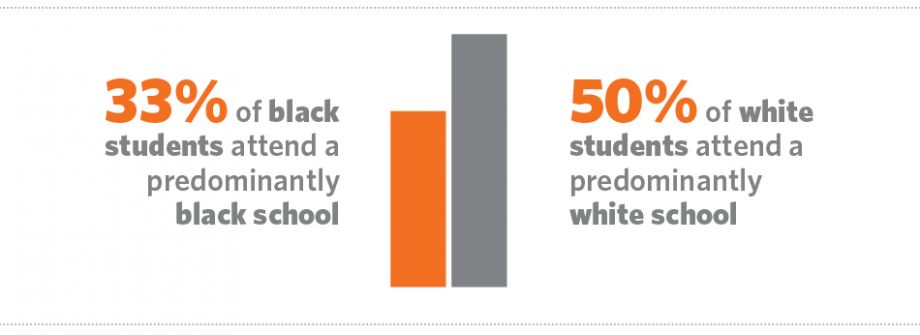
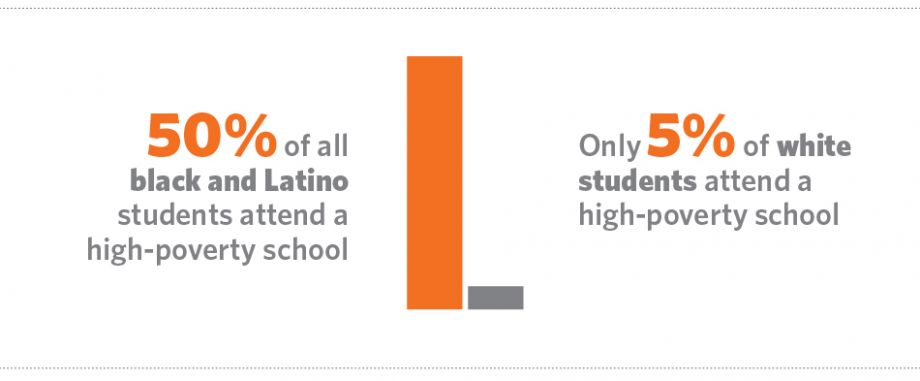
But in many cases these efforts have almost exclusively targeted low-income, minority schoolchildren who, as a whole, attend schools that are more segregated by race and class today than they were in the late 1960s. Indeed, some scholars argue the reform movement has exacerbated already rampant school segregation by focusing so much on the creation of “90/90/90 schools” — schools where more than 90 percent of the students are low-income, more than 90 percent are from ethnic minorities and more than 90 percent meet set academic standards.
The pushback against racially isolated charter schools is a growing phenomenon not only in New Orleans, but also in New York City, Denver and Washington, D.C. — all cities where the number of charters has grown significantly in recent years. In New Orleans, about 80 percent of the public schoolchildren now attend charters; in D.C., more than a third do.
Denver’s Bill Kurtz, one of the earliest and most vocal advocates of integrated charters, argues school reformers could achieve better results if they made desegregation more of a priority.
“College completion rates are going to be higher for kids who come from diverse schools,” said Kurtz, who founded a network of integrated charter schools in Denver eight years ago that Densen and others have looked to as a model. He made the remark during a 2011 panel discussion on school segregation hosted by Teach for America. “I don’t say we need to stop 90/90 schools. I just say we need a new paradigm in this country around creating multiple schools to address these issues.”
Those who push for more integrated urban schools, and charter schools in particular, usually do not frame their work in the context of urban revitalization. Instead, the educators describe the benefits more strictly in educational terms: Studies have shown that children make greater academic gains if they attend socioeconomically diverse schools; and students of all races and classes can best learn empathy and other skills they will need to compete in a “global society,” one of Densen’s favorite phrases, if they study alongside children from different cultures and backgrounds.
When pitching his school to community groups, for instance, Densen noted that in the not-too-distant future, “there will no longer be an ethnic majority in this country. We need to prepare students who can navigate those changes.”
Yet the movement to create more diverse schools holds deep implications for urban redevelopment. In the short run, if some of these schools open in historically impoverished, segregated neighborhoods, they could spur increased residential integration. In New Orleans, for instance, highly controversial efforts to rebuild former housing projects as mixed-income developments have, in some cases, come hand in hand with plans to open more integrated schools.
In the long run, integrated schools could play a role in keeping and attracting middle-income families who want to live in a diverse community and send their children to equally diverse public schools. Ironically, many suburban communities today have more socioeconomically and racially diverse schools than their urban counterparts.
Lashunda Bradstreet, a New Orleans parent who sends her daughter to one of the city’s few racially diverse schools, said, “I really didn’t want her to go to a school where there are just African Americans because the world is not just about the African-American experience.”
It’s not by accident that schools today are more segregated than they were 50 years ago. Densen and others are fighting against a potent blend of top-down policies and grass-roots mistrust that have led to increased school segregation in cities and schools across the country over the last two decades.
At all levels of government, political support for school desegregation has waned. Most notably, the U. S. Supreme Court invalidated voluntary school desegregation plans in a 2007 decision, making it much more difficult for public school systems to use a child’s race in school assignment decisions. The case arose from challenges to voluntary desegregation programs used in Seattle and Louisville public schools.
Meanwhile, the federal government has decreased its financial support for magnet schools, many of which were created in the 1970s and 1980s to spur integration. Magnets typically bring together diverse groups of students interested in studying a common theme, like the arts. Federal funding for magnets peaked in 1989, but by 2010 charter schools received more than twice as many federal dollars as magnets.
Support for school desegregation has also ebbed at the local level. In 2009, for instance, Republicans won a majority of seats on the Wake County School Board in Raleigh, N.C., and quickly moved to dismantle a school integration program there that limited the proportion of low-income students to 40 percent in any one school. (Proponents of school integration have recently regained a majority on the board.)
But human behavior and racial mistrust have further fueled school resegregation. Experts note that many white and middle-class families still leave schools when they become the minority (which will happen with increased frequency as the percentage of whites in the overall population continues to shrink). Meanwhile, Latino, black and poor parents often have good reason to fear their children will be discriminated against — and their needs neglected or ignored — in schools where they are in the minority. In many cities, black students bore the brunt of the sacrifice and suffering during school integration efforts in the 1960s and ‘70s; they often had to travel long distances to attend school in neighborhoods where they endured racist taunts, isolation and violence.
“Some [black and Latino] parents wonder, ‘Why should my kid have to get up at 4:30 in the morning to go across town to be abused?’” said Gloria Ladson-Billings, a professor of educational policy studies at the University of Wisconsin-Madison.
For most of their 20-year history, charter schools have aggravated these trends rather than ameliorated them.
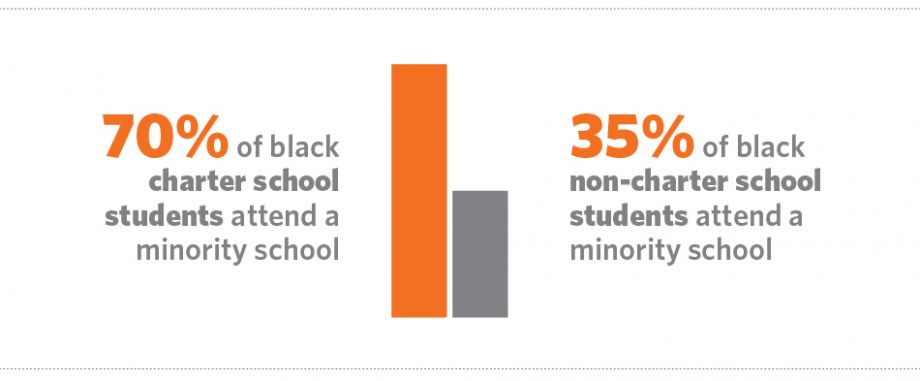
A 2010 report by the Civil Rights Project at UCLA found that charter schools are, on average, more segregated than traditional schools. Specifically, the report found that 70 percent of black charter students attend school in “intensely segregated settings,” or ones where more than 90 percent of the students are members of traditionally under-represented minorities. By comparison, only about 35 percent of black students in traditional schools learn in intensely segregated settings.
There are several explanations for the difference: Leaders of some ethnic communities, including the Hmong in Minneapolis and Milwaukee, have opened charter schools specifically tailored to their own children’s culture and needs. These schools are segregated by design.
Further, the federal government only gives start-up grants to charters with open admissions policies, meaning charter schools that want to achieve diversity through weighted lotteries have to forgo the grants (as opposed to lesser-funded magnet schools, which earn grants specifically to desegregate). This policy discourages integration by design.
But the single biggest force may be emulation of the “90/90/90” model popularized by such high-performing charter school networks as KIPP (the Knowledge is Power Program), which encompasses more than 100 schools across the country; Achievement First in Connecticut and New York City; and the Noble Network of charter schools in Chicago. These schools are usually designed specifically for low-income minority students, most of whom live in cities. They tend to feature longer school days and years, a back-to-the-basics curriculum aimed at catching students up quickly, teachers who work longer hours as a matter of course and rigid discipline structures. Many of these components make them less palatable to middle-class families who do not want their children to attend a school focused on discipline and intense academic remediation.
“I wasn’t sure if my daughter’s needs would be met in that education environment,” said Densen, who added that he now has mixed feelings about the “directiveness” of many 90/90/90 schools, although he believes many of them do great work. “The best thing schools can do is foster autonomy,” he said. “And I do wonder how much student autonomy is valued at schools that place so much emphasis on unity, uniformity and strong consistency of culture.”

This tension erupted in New Orleans’ Bywater neighborhood in recent years, where KIPP planned to add new school sites. A group of predominantly white, middle-class parents protested the move, arguing they wanted a less test-focused, rigid school environment (they also said they wanted a more “diverse” setting for their children, but were a strikingly un-diverse group). They met fierce opposition from several low-income, black parents whose children attended KIPP schools. A local journalist dubbed the confrontation “KIPPsters vs. Hipsters.”
Nationally, an influential network of funders and foundations has emerged to support the “KIPPsters” in recent years. They include the Doris and Donald Fisher Fund, started by the founder of The Gap, and the Walton Family Foundation, started by the founder of Walmart.
“School reformers, state and local education officials, exemplary charter-school operators, and managers of philanthropic foundations make it very clear that they are primarily in the business of educating poor black and Hispanic children,” wrote Frederick Hess, a scholar at the American Enterprise Institute, in a widely-circulated essay last year. “Anyone who has spent much time in the company of school reformers in the past decade has seen this practice turn almost comical, as when charter-school operators try to one-up one another over who can claim the most disadvantaged student population.”
Early one recent morning at Morris Jeff Community School, a 2-year-old charter in New Orleans, more than 100 youngsters gathered in the school cafeteria to hear morning announcements, say the Pledge of Allegiance and sing a rendition of Louis Armstrong’s “What a Wonderful World.”
With about three black children for every two white ones, Morris Jeff is the only existing school in New Orleans’ Recovery School District that comes close to mirroring the demographics of the city as a whole. The Recovery School District took over most of the city’s schools after Katrina.
According to the 2010 census, about 60 percent of New Orleanians are black, 33 percent white and 24 percent live below the federal poverty level. At Morris Jeff, about 55 percent of the students are black, 40 percent white and 5 percent Hispanic or Asian. More than half qualify for free or reduced price lunch. Morris Jeff is one of few local models for the kind of school Josh Densen hopes to create: Open to all, yet racially and socioeconomically diverse.
“We have kids who come in two years behind and kids who are the children of professors and have been read to every day since they were born,” said Broderick Bagert, Morris Jeff’s founding board president. “We represent a very different model of school reform than the dominant one in New Orleans and the rest of the country.”
Bagert and current board president Aesha Rasheed said they routinely encountered skepticism from school officials and funders who doubted they could even create a diverse public school in New Orleans. The city’s schools were intensely segregated long before charter schools expanded rapidly after Katrina. Only a few public schools with some form of admissions criteria have enrolled significant numbers of white and middle-class families over the last two decades. In 2004, more than 90 percent of the student population was black at 114 of the city’s 129 schools.
Bagert recalled one potential foundation funder who essentially asked him, “Could you be more naive?”
“There was this assumption that the schools are segregated and no one can change that,” Bagert said. “If charter schools are supposedly all about experimentation and local control, why is it that such a disproportionate number have such a very similar pedagogy, curriculum and structure? Part of the answer is the existence of a large-scale funding mechanism that only funds a certain kind of school.”
Morris Jeff’s founders discovered that many parents craved a diversity that did not exist in the city’s open enrollment public schools.
“We have kids who come in two years behind and kids who are the children of professors and have been read to every day since they were born.”
“I selected Morris Jeff explicitly because it was going to have a mixed population both racially and socioeconomically,” said Brian Beabout, who is white and has a kindergarten student at Morris Jeff. Beabout, an assistant professor of educational leadership at the University of New Orleans, taught in racially isolated public schools in the city before getting his doctorate.
He and Bagert do not buy the claim of many charter school advocates that white families will return to the public schools once test scores grow high enough.
The schools will only desegregate, they believe, if educators do the hard work of convincing parents — black and white — that their schools are designed to meet the needs of all children, and not a single demographic, well before they open their doors. After all, school integration efforts of the 1960s and ‘70s failed to take root partly because top-down policies shifted, but grass-roots racial prejudices did not.
“The middle class did not leave the schools because of test scores,” said Bagert. “They left because of racial mistrust.”
Initially, Morris Jeff distanced itself from the school reform movement. Its founding community members were not even sure they wanted to open the school as a charter because they were distrustful of the quasi-public, quasi-private schools.
But Kurtz and Densen have long supported charters and current reform efforts. They hope the spread of schools like theirs will help create alternatives in a movement that has been obsessed at times with a single, usually racially isolating model.
Kurtz opened his first school, the Denver School of Science and Technology, in 2004 with the support of a grant from Bill Gates. Although he has since become a leader in the push for diverse charters, integration was not one of his original goals. “Once the school was open and we realized how important and significant that was, it became more central to our work,” he said.
At each of the six schools that make up the DSST charter network today, between 45 percent and 75 percent of the students are low-income. The schools hold random lotteries to determine which students can attend. But at most of them, the names of children from low-income families go into one pot, while the names of children from middle and upper-income households go into another one to ensure socioeconomic diversity. (Few, if any, charters weight lotteries based on race since they could easily face a legal challenge stemming from the 2007 Supreme Court decision.)
Kurtz agreed with Bagert that many well-heeled foundations have prioritized 90/90/90 schools in recent years, essentially decreeing that “all other models aren’t worth funding.”
“We’ve worked really hard over the last two to three years to change that,” he added.
It’s partly because of those efforts that Densen, a former teacher at KIPP STAR in Harlem, decided to open Bricolage Academy. Densen supports the KIPP model and believes the spread of schools aspiring to be 90/90/90 programs (only a fraction actually achieve that status) has helped some low-income families.
But as a teacher, he came to the uncomfortable realization that he would probably not send his own children to the school where he worked — where the curriculum and approach were designed for students who started behind grade level.
After earning his M.B.A. from Wharton, Densen moved to New Orleans to work for The Achievement Network, a group that encourages schools to share data and test score results during the school year, with the goal of better gauging their strengths and weaknesses.
He had always hoped to start his own school someday. And after listening to a panel discussion on school segregation in 2011, Densen knew exactly what kind of school he wanted to open.
Kurtz, who was on the panel, took the reformers in attendance to task. He argued that at times, the reform movement “has looked down on integrated schools because, quote, they are not 90/90 schools. I would challenge the movement to change that.”
“We have called education reform the civil rights issue of our time,” Kurtz added. “Yet it’s ironic that we call it that, because we sometimes ignore the civil rights piece within the movement.”
Leaders of diverse charter schools are not, for the most part, trying to lure large numbers of white or middle-class families from the suburbs into the city. Most of the wealthier families they hope to attract are already settled in urban neighborhoods, whether newly gentrified or not. In that sense, their efforts are more the result of gentrification and neighborhood redevelopment than an intended driver of the trends. (They could still, however, accelerate redevelopment, whether intentionally or not, depending on where they locate.)
Indeed, while these schools certainly hold the potential to help shape more diverse neighborhoods, their first and foremost concern is education. As Richard Kahlenberg, a senior fellow at The Century Foundation, put it, “the discussion today is framed more in terms of education outcomes.”
Advocates point to studies like one in the socioeconomically diverse schools of Montgomery County, Md. It found that low-income students in public housing who attended predominantly middle-income schools significantly outperformed low-income children who remained in schools isolated by race and class, even if the latter schools received infusions of extra resources.
“We have called education reform the civil rights issue of our time. Yet it’s ironic that we call it that, because we sometimes ignore the civil rights piece within the movement.”
Like Densen and other founders of more diverse charter schools, Allison Keil was driven partly by the fact that she could not find a nearby public school where she wanted to send her own child. She wanted a school with a progressive curriculum focused on project-based, collaborative learning. And she also wanted diversity.
With that in mind, she co-founded Community Roots charter school in Brooklyn’s Fort Greene neighborhood six years ago with the explicit goal of serving a diverse population of students.
Community Roots, located near three public housing developments, shares a building with another predominantly black school. When it first opened, staff and families at its neighbor school were unaccustomed to seeing middle-class white children attending school in that corner of Fort Greene. They asked, “Why are white people coming into our school building for the first time?” Keil recalled.
Over time, however, school officials found themselves overrun by middle-class families, and the percentage of children eligible for free and reduced price lunch dropped dramatically. Gentrification began to impede their efforts.
“The gentrifying parts of Fort Greene have much more access to information about schools,” said Keil. For instance, they are much more likely to be on neighborhood email lists where information about Community Roots is posted. “Most charter schools are wondering why the more advantaged socioeconomic classes are not searching them out,” said Keil. “We have the opposite problem.”
To restore some measure of socioeconomic diversity, Community Roots has actively recruited in Head Start centers, which serve low-income 3- and 4-year-olds, since it opened. Next year, it also plans to start setting aside 40 percent of its seats for children who live in public housing within a half mile of the school.
“I don’t mean to be pessimistic, but if we don’t take this on in the public schools and create schools that are diverse, then we are in really big trouble,” said Keil. “We’re just continuing to support segregation.”
Many experts caution that creating integrated schools accomplishes very little if students are then re-segregated within the four walls — or if educators overlook the needs and wishes of one group.
“Simply having an environment where [different] kids are sitting next to each other does not mean they are getting a quality education,” said Beverly Daniel Tatum, the president of Spelman College in Atlanta, the oldest historically black college for women in the country. Tatum made the comment during the 2011 panel where Bill Kurtz advocated for more integrated charter schools.
In a diverse urban setting, poor children benefit from the extra resources and political clout that large numbers of middle- and upper-income families often bring to a school. They may also gain first-hand exposure to the networks and connections that help wealthier families make it to and through college.
But they can also wind up funneled into less rigorous tracks or programs, as has happened in countless magnet schools across the country. Or they might discover teachers’ expectations for them are lower. Or they might face more severe punishment than a white student for the same infraction.
In his Pulitzer Prize-winning epic, Common Ground, J. Anthony Lukas described how a group of middle-class white parents in 1970s Boston mistakenly thought they were helping all children in their community by pushing for “open education” at their neighborhood school on the city’s South Side. In an open model, a child’s education is highly self-directed. The white parents ignored the protests of black parents at the school who complained that “an emphasis on personal choice was fine for children with a lifetime of choices ahead of them, but not for the poor, who would need discipline and order to prevail over life’s rigors.”
Lukas writes that black activists felt “the white middle-class settlers…were trying to make the South End — and the Bancroft [school] — over in their own image; in effect, they had turned the Bancroft into a private school, serving their own needs and priorities. They might talk a lot about racial integration, about how much they wanted blacks and other minorities at the school, but they weren’t about to give blacks any real power.”
Indeed, Ladson-Billings at the University of Wisconsin-Madison points out that the achievement gap between students of different races remains very high in many small, liberal cities like Madison, Wis. and Cambridge, Mass. — communities that pride themselves on the diversity of their schools.
“Black activists felt the white middle-class settlers were trying to make the South End — and the Bancroft school — over in their own image.”
Leaders of racially and socioeconomically diverse charters say they try to be conscious of hearing and incorporating the viewpoints of all parents. But they acknowledge how easy it is to develop blind spots. Beabout, who served a term on the board of Morris Jeff, said poor parents have a harder time making it to school meetings or functions since they often work long hours and lack transportation.
The school engages in constant outreach to parents — always asking them what type of school they want for their children — and employs a diverse staff. But, even with those efforts, Beabout and others concede they still have more work to do to cultivate a diverse group of parent leaders.
“We started noticing that a lot of middle-class, college-educated parents…stepped into leadership roles,” Beabout said. But, he added, “the last thing we want is to create a two-tiered school for both parents and students.”
On a recent evening, Densen presented his vision for Bricolage Academy to a group of parents and community members at the Desire Fellowship, a ministry located in the heart of New Orleans’ Ninth Ward — the same neighborhood where, half a century ago, a 6-year-old Ruby Bridges became the first African-American child to attend an integrated Southern school.
New Orleans suffered from longstanding school segregation well before charter schools appeared on the scene. Prior to Katrina, 94 percent of the city’s public school students were black, New Orleans had one of the highest rates of private school attendance in the country, and only a small minority of the public schools enrolled any white families at all.
If anything, the meeting at the Desire Fellowship highlighted how differently people view what constitutes a quality education. Densen opened by asking what single thing a school needs most. One person said the latest technology. Another said consciousness of different learning styles. A third said accountability, and a fourth said investment in the community.
A few people came because they were suspicious of yet another white transplant hoping to start a charter school in the city. But most were genuinely curious about the notion of a racially and socioeconomically integrated school, particularly one that would not test students before admitting them.
Oscar Brown, the director of ministries at the fellowship, agreed to host the meeting because he found Densen’s idea appealing. Brown was born in the nearby Desire Projects and grew up attending de facto segregated public schools where, he said, “I never saw anyone of any other race.”
Brown pays tuition to send his 9-year-old son, Oscar Jr., to a nearby parochial school in the Bywater neighborhood that enrolls half black students and half white ones. But he doesn’t believe parents should have to pay a premium to expose their kids to children of different colors and backgrounds.
Many people have long sought to integrate urban communities primarily through top-down policies — creating more mixed-income housing, for instance, or redrawing school district boundaries to create more diversity. Brown thinks such structural changes play an important role. But without hard, honest conversations at the grass-roots level, schools can wind up integrated on paper alone or quickly re-segregate. People don’t change simply because policies do.
New Orleans already has some racially and socioeconomically diverse neighborhoods, including Mid-City, Bywater and parts of Uptown. But as the history of that city has shown, simply putting people of different colors and backgrounds beside each other is meaningless if their lives still never intersect. It’s like the concept of “parallel play,” which describes toddlers playing side by side yet utterly disengaged from each other.
If done right, integrated schools could help bring about a more integrated society. But there’s plenty of potential to go wrong.
The first step for many New Orleanians is getting past a fear of the unknown, Brown said.
“People are afraid. They are afraid to break down those walls. They are afraid to even challenge them.”
Our features are made possible with generous support from The Ford Foundation.

Sarah Carr is the author of Hope Against Hope: Three Schools, One City, and the Struggle to Educate America’s Children. Her work has been honored with numerous national awards and fellowships, most recently a Spencer Education Journalism Fellowship at Columbia University.

Alex Lukas was born in Boston in 1981 and raised in nearby Cambridge. With a wide range of artistic influences, Lukas creates both highly detailed drawings and intricate Xeroxed ‘zines. His drawings have been exhibited in New York, Boston, Philadelphia, Los Angeles, San Francisco, London, Stockholm and Copenhagen as well as in the pages of Megawords, Swindle Quarterly, Proximity Magazine, The San Francisco Chronicle, The Village Voice, Philadelphia Weekly, Dwell, Juxtapoz, The Boston Globe, The Boston Phoenix, Art New England and The New York Times Book Review. Lukas’ imprint, Cantab Publishing, has released over 35 small books and ‘zines since its inception in 2001. He has lectured at The Maryland Institute College of Art, The University of Kansas and The Rhode Island School of Design. Lukas recently partnered with the The Borowsky Center at The University of the Arts in Philadelphia to produce an eight-color offset lithograph as part of the 2011 Philagrafika Invitational Portfolio. His work was also recently acquired by the West Collection as part of the 2011 West Prize. Steven Zevitas Gallery presented an exhibition of new works on paper this spring. Lukas is a graduate of the Rhode Island School of Design and now lives and works in Philadelphia.

Next City is a nonprofit news organization that believes journalists have the power to amplify solutions and spread workable ideas from one city to the next city. Our mission is to inspire greater economic, environmental, and social justice in cities.
Learn more about us →
20th Anniversary Solutions of the Year magazine







 Never Miss A StoryDownload our app